When Austerity Feeds Inequality: A Hard Look at Finland’s Fiscal Priorities
By Harshwardhan Saini
This article has been sitting in my drafts for months. I kept telling myself I needed more data, more sources, a better angle. But the truth is simpler than that. As a resident of Finland, a public health researcher, and someone who ran as a political candidate in the 2025 regional elections, I have watched this government's fiscal choices with growing alarm, and I could not keep treating silence as neutrality. Not when the consequences land on the people around me every day.
Finland is often held up internationally as a model of good governance, social equity, and balanced prosperity. That reputation was earned over decades, through deliberate investment in public systems that gave ordinary people a genuine shot at a good life. But over the past two years, the coalition government led by Prime Minister Petteri Orpo has pursued a combination of deep spending cuts to public welfare and generous tax relief for corporations and higher earners, all under the banner of fiscal responsibility. The numbers they cite sound reasonable in isolation. The logic, once you look closely, does not hold together.
The debt reality, and who actually owns it
The government's central justification for austerity is Finland's rising national debt. And yes, the numbers are significant. According to the European Commission's November 2025 forecast, Finland's public debt stood at roughly 82.5% of GDP at the end of 2024 and is projected to climb to around 92% by 2027 (European Commission, Economic Forecast for Finland, November 2025). The Bank of Finland's own bulletin from January 2026 projects the debt ratio reaching 88% by end of 2025, with continued growth of 1 to 2 percentage points annually through 2028 (Bank of Finland Bulletin, January 2026). These are not trivial figures.
But the conversation almost never gets to the question that actually matters: who holds this debt, and what does that mean?
Most of Finland's government debt is held domestically, by institutions like the Bank of Finland, municipal pension funds, and public sector entities (State Treasury Finland, 2024). This is a fundamentally different situation from, say, Greece during its sovereign debt crisis, where foreign creditors held enormous leverage over domestic policy. When a country borrows from its own institutions, the interest payments cycle back into the domestic economy. They fund pensions. They support public services. They stay within the system. The risk profile of domestically held debt is categorically different from externally held debt, and any honest fiscal discussion needs to start there.
The household metaphor that politicians love to reach for, "tightening our belts" and "living within our means," obscures more than it reveals. A household cannot create currency. A household cannot set interest rates or regulate markets. A household does not have the power to stimulate demand during a recession. Governments can do all of these things, and in downturns, they must. Public debt, when deployed strategically, is an investment tool. Japan has maintained a debt to GDP ratio well above 200% for years, with the vast majority held domestically, and its economy has not collapsed (Scope Ratings, 2024). The comparison is not perfect, but it illustrates a principle: the composition and purpose of debt matter far more than the headline number.
What is actually being cut, and who pays
The scale of what this government has done is worth sitting with for a moment. Since taking office in 2023, the Orpo coalition has implemented budget adjustments totalling roughly 10 billion euros across spending cuts and tax increases (Yle, September 2025). The areas absorbing the deepest damage include healthcare and wellbeing services, education at every level from early childhood through higher education, municipal support, development cooperation, and the social safety net more broadly.
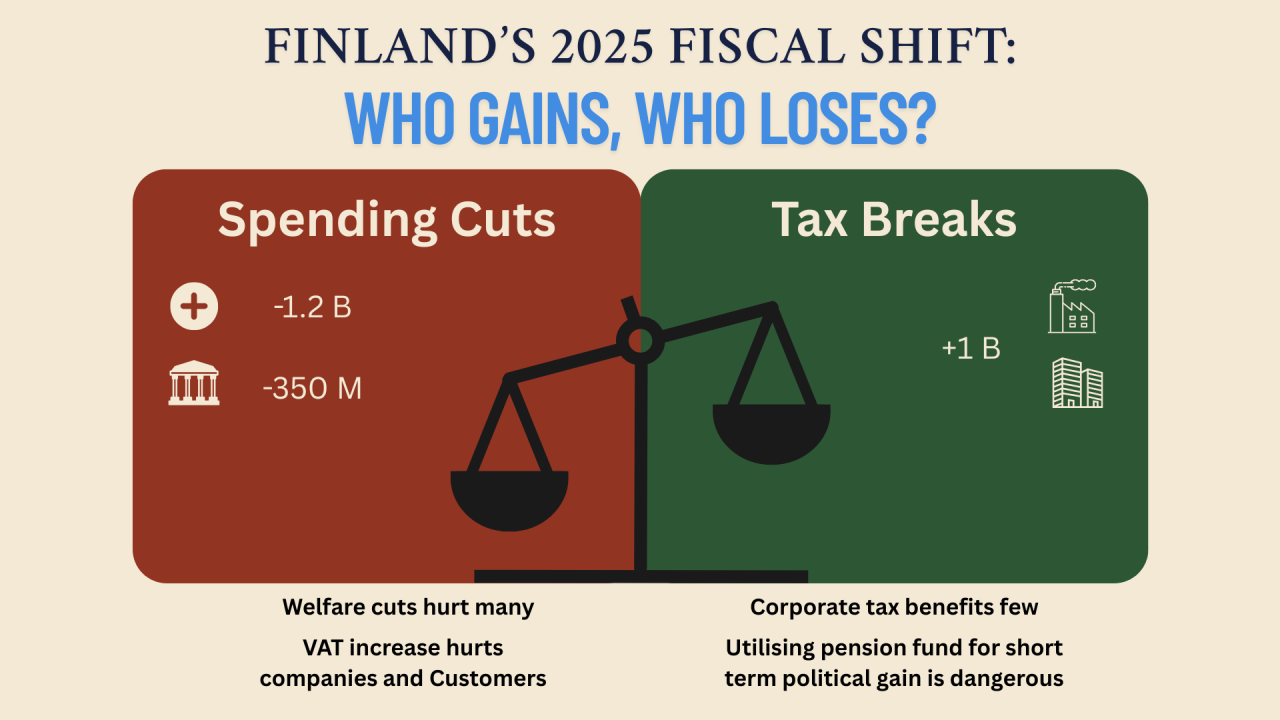
Healthcare cuts alone exceed 1.2 billion euros. In practice, this means fewer staff in an already stretched system, longer waiting times, and a growing number of people who simply fall through the gaps (Ministry of Social Affairs and Health; Yle). For a country with an ageing population and rising care needs, cutting the healthcare budget is not prudent fiscal management. It is storing up far larger costs for the future, in emergency interventions, in lost productivity, in human suffering that compounds over time.
Education cuts of over 350 million euros across vocational training, early childhood education, and universities carry a similar long tail (Ministry of Education; Yle). Education is not a line item you can trim without consequence. It is the mechanism through which a society renews its capacity to innovate, compete, and adapt. Every euro removed from education today is a capability deficit that shows up in the labour market five, ten, twenty years from now.
Meanwhile, the government raised the general VAT rate to 25.5%, one of the highest in the EU. Value added taxes are inherently regressive. They consume a larger share of income for lower and middle income households, who spend more of what they earn on everyday necessities. A pensioner buying groceries in Espoo pays the same VAT rate as a corporate executive in Katajanokka, but the burden is not remotely comparable.
And here is what makes the overall direction so difficult to defend: at the same time as these cuts and regressive tax increases, the government announced roughly one billion euros in income tax reductions, with the largest benefits flowing to higher earners, and committed to lowering the corporate tax rate to 18% by 2027 (Yle, 2025). The fiscal policy analysis published by the Kalevi Sorsa Foundation in Social Europe showed clearly that the net effect of the April 2025 tax decisions is regressive. Higher income groups receive proportionally larger benefits, while the consolidation that supposedly justified the cuts has been reduced to a fraction of the original target (Social Europe, August 2025).
To put it plainly: the government cut public services that ordinary people depend on, raised consumption taxes that hit the poorest hardest, and then redirected fiscal space toward tax relief for those who needed it least. No meaningful conditions were attached to the corporate tax cuts. No requirements for job creation, climate commitments, wage floors, or community reinvestment.
The self-defeating cycle
What makes this particularly frustrating from an evidence standpoint is that the economic case against this approach is not speculative. It is being modelled and documented in real time.
The Finnish Centre for New Economic Analysis (UTAK) published a study applying the European Commission's own debt sustainability model to Finland's consolidation plans. Their finding was stark: fiscal tightening of roughly 9.7 billion euros between 2027 and 2031 would reduce Finland's GDP by up to 20 billion euros over time, and would fail to reduce the debt to GDP ratio at all (Helsinki Times, April 2026; Social Europe, October 2025). The proposed national debt brake, which would impose even stricter consolidation targets than EU rules require, risks locking Finland into precisely the kind of self-defeating austerity cycle that Southern European countries experienced in the 2010s.
UTAK's executive director Lauri Holappa put it directly in an interview with DW: "If we now impose strict austerity, along with strict fiscal rules, there's the risk that we cannot get back on the growth path" (DW, December 2025). This is not a fringe position. The Bank of Finland's own forecasts show that consumer confidence remains suppressed, private consumption has stalled, and the household savings rate is elevated, not because people have surplus income, but because they are afraid (Bank of Finland Bulletin, June 2025). About a third of Finland's workforce is dependent on government funding in some form, and constant talk of cuts keeps that entire segment of the population cautious with their spending. You cannot cut your way to growth when 80% of GDP comes from domestic sectors like household consumption, public services, construction, and retail (DW, December 2025).
The OECD's May 2025 Economic Survey of Finland acknowledged that consolidation measures have been taken, but noted that fiscal policy changes announced in April 2025, including income and corporate tax reductions plus increased defence spending to 3% of GDP by 2029, will slow the pace of consolidation. Their language was measured, as OECD language tends to be, but the implication was clear: the government's own policy moves are undercutting the fiscal discipline they claim to be pursuing (OECD Economic Surveys: Finland, May 2025).
The European Commission has now formally placed Finland under the Excessive Deficit Procedure, with the deficit projected at 4.5% of GDP in 2025 and debt on track to reach 90% of GDP (European Commission, November 2025). This is not a country that is spending recklessly on social programmes. This is a country whose economic underperformance, driven by years of weak growth, the collapse of trade with Russia, massive defence commitments, and now contractionary fiscal policy, has eroded its revenue base faster than any cuts can compensate.
The political fallout is already visible
The public is not passive in the face of all this. In early 2024, austerity measures triggered strikes involving up to 300,000 workers across the country (AP News, 2024). The 2025 municipal and regional elections, held in April, delivered a sharp verdict. The Finns Party, the coalition's second largest partner and the party that had promised voters it would protect working people from benefit cuts, collapsed to below 8% of the vote, down from 14.5% in 2021 and 20.1% in the 2023 parliamentary election (Helsinki Times; Yle). Their own chair, Riikka Purra, described the result as "ugly numbers" and acknowledged an "unprecedented red shift" in Finnish politics (Helsinki Times, September 2025).
The Social Democrats, running on a platform of opposition to austerity, gained 5.3 percentage points and emerged as the largest party nationally. The Left Alliance also gained ground, particularly among blue collar workers who had previously supported the Finns Party (Jacobin, April 2025; Yle, July 2025). Current polling from late 2025 shows SDP at roughly 24 to 25%, with the governing coalition's combined support at its lowest point since taking office (Yle, December 2025).
This is not ideological noise. When people vote against the party that promised to protect them and instead cut their services, that is a rational response to a broken promise. When 300,000 workers walk off the job, that is not hysteria. That is a population telling its government, in the clearest terms available, that the social contract is fraying.
What a different path could look like
None of this means that Finland has no fiscal challenges. It clearly does. An ageing population, rising defence needs driven by the geopolitical reality of sharing a 1,340 kilometre border with Russia, and the structural economic damage caused by severing trade and energy ties with Moscow after 2022: these are real pressures that require serious responses.
But serious does not mean reflexive cutting. The UTAK study suggested an alternative approach: tax based consolidation of around 8 billion euros combined with 5 billion euros in targeted public investment or equivalent private sector support. Their modelling showed this path would meet fiscal targets while actually supporting economic activity, rather than suppressing it (Helsinki Times, April 2026).
Progressive taxation is part of this. Finland still taxes capital income, including dividends and interest, at lower effective rates than earned wages. A system that asks less of unearned wealth than it does of labour is not neutral. It is a policy choice that concentrates advantage. Reforming this is not radical. It is a return to the principle that the tax system should reflect the capacity to contribute.
Corporate tax reductions should come with accountability. If the state is going to forgo revenue to improve conditions for business, it is entirely reasonable to expect something in return: living wages, measurable climate action, local hiring commitments, reinvestment in the communities where profits are generated. Tax cuts with no strings attached are subsidies, not strategy.
And public services need to be understood for what they are. They are not costs to be minimised. They are the infrastructure that makes everything else possible. They are what allows a single parent to go to work because childcare exists. They are what keeps a depressed teenager in school because counselling is available. They are what means a pensioner does not die waiting for a diagnosis because the clinic still has staff. When you cut these systems, the costs do not disappear. They are transferred to families, to communities, to future budgets. They grow.
This is personal
I will be honest about where I stand. I am not a dispassionate observer. I ran in the 2025 Western Uusimaa regional elections as a Green Party candidate. I was the only candidate in my region who did not speak Finnish or Swedish as a first language. I came 11th among male candidates (in Greens) and was selected as a deputy member for the LUVN Services and Personnel Committee and City of Espoo's Community Committee. I have spent years researching human behaviour and public health. I run a civic advocacy organisation here in Espoo. I live here. I pay taxes here. I use the public systems that are being hollowed out.
And I know what these cuts look like up close, because Yle's investigative MOT programme followed my wife and me for nearly a year as part of their documentary "Saksittujen tukien seuraukset" (The Consequences of Cut Benefits), which aired in April 2025. We were two of four people they tracked to show what the government's social security cuts actually do to real lives. My wife was taken into state care as a child, fought her way through adult upper secondary school, and earned her place at the University of Helsinki. The aftercare system that supported her through that journey was one of the things this government chose to cut. Meanwhile, despite holding a degree in neuropsychology from India, I have been unable to secure professional practice rights here in Finland. I have delivered newspapers, worked as a food courier, and spent years in civil society work. Our housing support was reduced. The removal of the protected income threshold made even part time work less worthwhile. We have had to take on debt just to stay afloat. When MOT requested interviews with Prime Minister Orpo, Finance Minister Purra, Employment Minister Satonen, and Social Security Minister Grahn-Laasonen about the impact of these cuts, all four refused (Yle MOT, April 2025).
So yes, my frustration is personal. But it is also grounded in evidence. The research is consistent. The economic modelling is clear. The public response is unambiguous. And the question that this government has failed to answer is the one that should come before any spreadsheet: who benefits from these choices, who bears the cost, and what kind of society are we choosing to build?
Finland deserves a fiscal policy rooted in foresight, fairness, and an honest accounting of consequences. What we have instead is short term political calculus dressed up as responsibility. And the people left behind by these choices are not abstractions. They are our neighbours, our colleagues, our parents, our children.
They deserve better. And so do you.
Sources
- European Commission. (2025). Economic Forecast for Finland, November 2025. https://economy-finance.ec.europa.eu/economic-surveillance-eu-member-states/country-pages/finland/economic-forecast-finland_en
- Bank of Finland Bulletin. (2026). From Targets to Actions, January 2026. https://www.bofbulletin.fi/en/2025/6/from-targets-to-actions/
- State Treasury Finland. (2024). Facts About Central Government Debt. https://www.treasuryfinland.fi/debt-management/facts-about-central-government-debt
- Scope Ratings. (2024). Finland Rating Update. https://scoperatings.com/ratings-and-research/rating/EN/178412
- Yle. (2025). How Finland's Budget Cuts Affect You. https://yle.fi/a/74-20181616
- Yle. (2025). Valtiovarainministeri: Elakerahastoa kaytetaan miljardien veronalennusten rahoittamiseen. https://yle.fi/a/74-20158319
- Yle. (2025). Palkansaajien verotus kevenee miljardeilla. https://yle.fi/a/74-20157854
- Social Europe. (2025). Finland's Austerity Gamble: Tax Cuts for the Rich, Pain for the Poor. https://www.socialeurope.eu/finlands-austerity-gamble-tax-cuts-for-the-rich-pain-for-the-poor
- Social Europe. (2025). Finland's Right-Wing Coalition Plans Fifty Years of Austerity Through National Debt Brake. https://www.socialeurope.eu/finlands-right-wing-coalition-plans-fifty-years-of-austerity-through-national-debt-brake
- Helsinki Times. (2026). Report: Spending Cuts Risk Deeper Economic Slowdown in Finland. https://www.helsinkitimes.fi/finland/finland-news/domestic/28709-report-spending-cuts-risk-deeper-economic-slowdown-in-finland.html
- DW. (2025). Finland: The Money Woes of the World's Happiest Country. https://www.dw.com/en/finland-the-money-woes-of-the-worlds-happiest-country/a-71144587
- OECD. (2025). OECD Economic Surveys: Finland 2025. https://www.oecd.org/en/publications/oecd-economic-surveys-finland-2025_985d0555-en.html
- AP News. (2024). Finland Sees Massive Strikes in Response to Austerity Cuts. https://apnews.com/article/99da91b3a1d89d47d1f48169428a7214
- Helsinki Times. (2025). Finns Party Collapses in Municipal Elections as SDP Wins Key Cities. https://www.helsinkitimes.fi/finland/finland-news/politics/26580-finns-party-collapses-in-municipal-elections-as-sdp-wins-key-cities.html
- Jacobin. (2025). Can the Red Wave Stop Austerity in Finland? https://jacobin.com/2025/04/finns-party-left-alliance-orpo
- Yle. (2025). SDP Retains Strong Lead as Support for Opposition Parties Rises. https://yle.fi/a/74-20197781
- Bank of Finland Bulletin. (2025). New Obstacles to Finland's Economic Recovery. https://www.bofbulletin.fi/en/2025/4/new-obstacles-to-finland-s-economic-recovery/
- Bank of Finland Bulletin. (2024). Sustained Efforts Needed to Turn Finland's Public Debt Ratio Around. https://www.bofbulletin.fi/en/2024/5/sustained-efforts-needed-to-turn-finland-s-public-debt-ratio-around